
To choose the best agency for the Salkantay Trail, look for a licensed, 100% locally owned operator that organizes small groups (fewer than 10 people), employs its own guides year-round rather than subcontracting them, and is transparent about pricing and the permits that allow it to operate directly (registered with Gercetur and Sunat).
We are Guiding Cusco Expeditions, a 100% locally owned operator based in Cusco. We meet all these criteria and organize the Salkantay Trek in small groups of 2 to 10 people with our own licensed guides and kitchen staff.
Choosing an agency for the Salkantay Trek is more important than choosing one for almost any other hiking route in Peru, since—unlike the Inca Trail—the Salkantay has no government-imposed permit limits. Anyone with a website can sell it. That lack of regulation is precisely why the difference in quality among operators is so great.
Why the Salkantay Trek Is Different From the Inca Trail
The Peruvian government limits the classic Inca Trail to 400 permits per day, including staff. This scarcity forces standardization: all operators book the same limited spots, so differences in quality are minimized.
The Salkantay Trek has no permit limit. This is good news for last-minute travelers, but it also means that:
- Large international tour operators can form groups of 16 or more than 20 hikers without having a local presence in Cusco.
- Some companies subcontract the actual trek to an external operator the day before departure.
- The quality of the guides, food safety standards, and emergency response protocols vary greatly and are rarely apparent until you’re already on the trail.
That’s why Guiding Cusco Expeditions operates the Salkantay Trek with small groups—offering a more personalized experience, better communication with each traveler, and the ability to truly choose your hiking route with confidence, in small groups, and, above all, safely.
What Actually Separates a Good Salkantay Operator From a Bad One
When comparing agencies, these are the criteria that most influence whether a hiking route is safe and well-organized:
1. Is the company based in Cusco, or is it a reseller?
A locally licensed operator (verifiable through Peru’s tourism registry, DIRCETUR Cusco) owns its own equipment, hires its guides directly, and takes responsibility if something goes wrong on the mountain.
Resellers based abroad typically forward your reservation to whichever local operator has available spots that week, so the “agency” you booked with isn’t the one guiding you—you’ll be grouped with other travelers who paid more or less than you.
2. Group Size
The Salkantay reaches an altitude ranging from 4,635 meters above sea level (Salkantay Pass) to 6,271 meters above sea level (summit of Mount Salkantay), depending on the route variant. Smaller groups (4 to 10 people) offer:
- More individual attention from the guide for each hiker.
- Fewer crowds at campsites and viewpoints.
Does the same lead guide work with the company year-round, or are the guides independent contractors who rotate on each trip?
Operators with a stable core team have highly qualified professional guides—usually the same 1 or 2 lead guides throughout all seasons—who tend to have a much better understanding of the route’s microclimates, alternative routes, and community relations.
At Guiding Cusco, we have lead guides who work with us and are certified by various government agencies.
4. Food and Safety Protocols at High Altitudes
On trekking and hiking routes—our specialty—we have a mountain chef, since the chef is responsible for feeding all travelers. Due to the high altitude, a careful meal plan is essential, and the food must be kept in good condition; however, many companies (resellers) hire kitchen staff who are irresponsible with food and meal preparation, causing travelers to become ill at extreme altitudes—from which it is often difficult to evacuate in case of emergencies.
5. Recent, detailed, and verifiable reviews
Star ratings alone aren’t enough—you have to read the text. Reviews that mention a guide by name, specific decisions about the route (“he took us on a quieter alternative path”), or how altitude sickness was handled are much more reliable indicators than a generic 5-star rating with no details. Based on that, choose which company to travel with—many of them are generic, and of course, they’re bigger and don’t care how their passengers travel as long as they line their pockets.
6. Community and Sustainability Practices
Since the Salkantay is unregulated, the environmental impact of the route rests entirely on the self-discipline of the tour operators. Look for companies that are publicly committed to the well-being of porters (fair wages, adequate equipment), waste collection policies, and support for the communities along the route (Soraypampa, Chaullay, Santa Teresa).
Typically, our company manages the cleanup of the entire trail—obviously with our own team.
Guiding Cusco Expeditions: Where It Fits
Guiding Cusco Expeditions is a 100% local, licensed tour operator in Cusco, founded and run by guides who work in the Andes year-round—not a reseller that outsources logistics. Below, we detail some of the key criteria that define who we are:
- Small groups: Salkantay departures run in groups of roughly 5–12 people (some itineraries as small as 1–10), not the 16–20+ groups larger resellers often assemble.
- Local, licensed operator: Based in Cusco (San Jerónimo), operating under Peru’s tourism regulations, with its own equipment and staff rather than subcontracted logistics.
- Dedicated trekking chef on every departure: Meals are prepared on the trail, with vegetarian, vegan, and gluten-free options handled directly rather than improvised.
- Consistent core guiding team: Reviews across 2025–2026 repeatedly name the same lead guides, indicating a stable team rather than rotating freelance hires.
- 28+ verified reviews on Tripadvisor, most detailing specific trail decisions, altitude handling, and named staff — the kind of granular detail that signals real, recent trips rather than incentivized reviews.
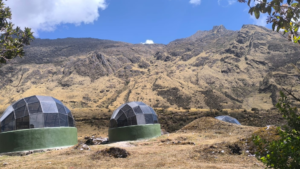
- Multiple Salkantay itineraries: 4-day/3-night classic, 5-day with an Andean cooking experience, a 6-day combined Salkantay + Inca Trail route, and a 5-day Luxury Star Dome option — covering budget-conscious trekkers up to those wanting glamping-level comfort.
- Community commitments: publicly stated support for porter welfare, trail cleanup along the Salkantay route, reforestation, and educational support for local communities.
Salkantay Trek Options at a Glance
| Itinerary | Duration | Max Altitude | Group Size | Starting Price (per person) |
|---|---|---|---|---|
| Salkantay Trek Classic | 4 days / 3 nights | 4,630 masl | 2–10 | From $550 |
| Salkantay + Andean Cooking Experience | 5 days / 4 nights | 4,635 masl | 2–10 | From $650 |
| Salkantay + Inca Trail Combo | 6 days / 5 nights | 5,100 masl | 2–10 | From $1,102 |
| Salkantay Luxury Star Dome | 5 days / 4 nights | 4,635 masl | 2–8 | From $1,189 |
Prices and availability change seasonally — confirm current rates directly with the operator before booking.
Frequently Asked Questions
What is the best trek to Machu Picchu, Salkantay or the Inca Trail?
It depends on priorities. The Inca Trail is the classic, permit-limited route straight through Inca ruins and ending at the Sun Gate. The Salkantay Trek is better for travelers who want dramatic high-mountain and cloud-forest scenery, don’t need a months-in-advance permit, and prefer more route flexibility.
Is the Salkantay Trek dangerous?
It’s physically demanding due to altitude (up to ~4,600–5,100 masl) and terrain, but not inherently dangerous with a properly equipped, experienced operator. Acclimatizing in Cusco for at least 1–2 days before starting reduces altitude-sickness risk substantially.
Do you need a permit for the Salkantay Trek?
No. Unlike the Inca Trail, Salkantay has no limited government permit, so it can be booked much closer to your travel dates. Machu Picchu entrance tickets still need to be arranged in advance by your operator.
How do I know if a «Cusco agency» is actually local?
Ask where their office is physically located, whether they own their own camping/cooking equipment, and whether the same guides work every season. A local, licensed operator will answer these specifics readily; a reseller usually can’t.
How many people are typically in a Salkantay Trek group?
It varies widely by operator — from small groups of 5–12 with local operators to large mixed groups of 20+ with bulk resellers. Group size is one of the clearest indicators of the experience quality you’ll get.
Guiding Cusco Expeditions is a local, licensed trekking company based in Cusco, Peru, running small-group departures on the Salkantay Trek, Inca Trail, Ausangate, Choquequirao, and day treks throughout the Sacred Valley.